
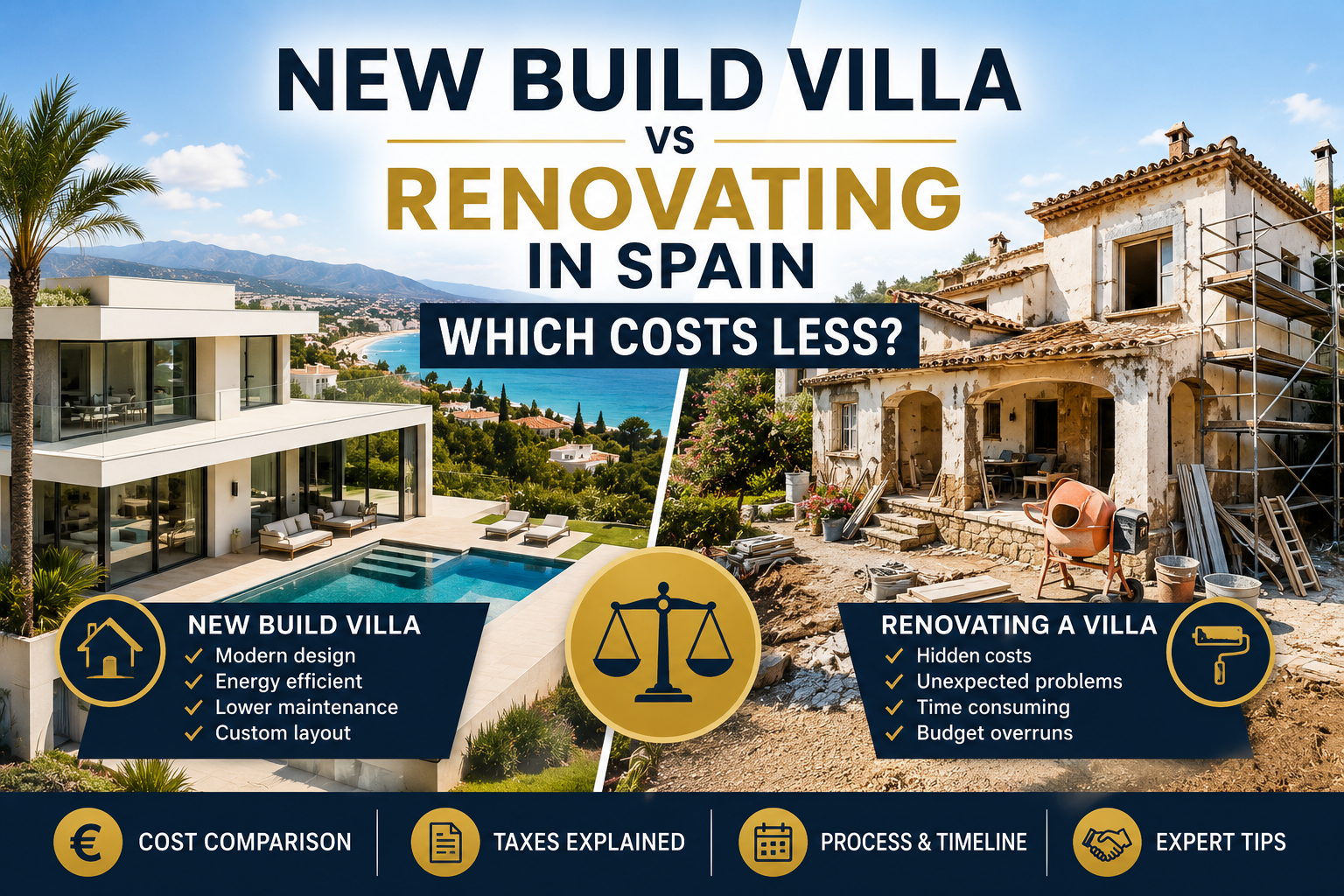
Buying an older villa and renovating it may seem like the cheaper way to own a property in Spain. The purchase price is often lower, the house already exists, and buyers naturally assume that improving an existing property must cost less than building a completely new home.
In reality, this is not always the case.
I speak with developers, builders and other property professionals on the Costa del Sol regularly, and one point comes up repeatedly: a major renovation can sometimes cost as much as, or even more than, building a new villa from the ground up.
The numbers can be surprising.
Depending on the property, location, materials and complexity of the project, renovating a villa to a good modern standard can cost around €2,000 per square metre or more.
Meanwhile, constructing a new villa may start from approximately €1,800 per square metre in certain cases.
Of course, these figures are only general examples. Construction costs vary enormously depending on the location, land, architect, finishes, technical requirements and quality of construction.
But they highlight an important question for anyone planning to buy a villa in Spain:
Is it better to renovate an existing property or buy or build a new villa?
Having visited numerous new developments, construction sites, completed villas and renovation projects, I believe the answer depends on much more than the initial purchase price.
How Much Does It Cost to Renovate a Villa in Spain?
There is no standard price for renovating a villa.
A relatively simple cosmetic renovation involving painting, flooring and updating bathrooms is completely different from a comprehensive refurbishment.
A major villa renovation may include:
- New electrical installations
- Plumbing
- Windows and doors
- New flooring
- Bathrooms
- Kitchen
- Air conditioning
- Heating systems
- Insulation
- Roof repairs
- Swimming pool renovation
- Terraces
- Landscaping
- Structural changes
Once you start changing the layout or structure of an older villa, costs can increase quickly.
A substantial renovation to a good modern standard can reach approximately €2,000 per square metre, and high-end projects can cost considerably more.
For a 250 m² villa, that could mean a renovation budget of around €500,000 before considering the original purchase price, taxes and unexpected expenses.
This is where many buyers make their first mistake.
They compare the purchase price of an old villa with the price of a new villa.
A better comparison is:
Purchase price + taxes + renovation + professional fees + unexpected costs
versus:
Land + construction + professional fees + taxes + financing costs
Only then can you realistically compare the two options.
Why Can Renovating an Old Villa Be So Expensive?
The biggest problem is uncertainty.
When building a villa from the ground up, the architect, developer and construction company start with a defined project.
With an older property, you may not know exactly what you are buying until work begins.
Removing floors, walls or ceilings can reveal problems that were not visible during the initial property inspection.
These may include:
- Old electrical installations
- Plumbing problems
- Water damage
- Insufficient insulation
- Structural issues
- Roof damage
- Humidity
- Illegal extensions
- Differences between the actual property and registered plans
Every unexpected problem costs money.
It can also delay the project.
This is one reason why some developers I speak with prefer building new villas rather than undertaking major renovations.
Starting from zero can provide significantly more control over the project.
How Much Does It Cost to Build a New Villa in Spain?
Building costs vary considerably across Spain.
The Costa del Sol, Madrid, Barcelona, Mallorca and Ibiza generally have different land and construction costs from less expensive inland regions.
For a good-quality modern villa, construction costs may start from approximately €1,800 per square metre in some projects.
However, this should never be interpreted as a fixed price.
A realistic budget depends on:
- Location
- Land conditions
- Villa size
- Architectural complexity
- Quality of materials
- Energy efficiency
- Swimming pool
- Landscaping
- Kitchens and bathrooms
- Smart home systems
- Professional fees
A simple contemporary villa and a bespoke luxury property with panoramic glazing, natural stone, designer interiors and extensive landscaping are completely different construction projects.
The final cost per square metre can therefore vary enormously.
Renovation vs New Build: A Simple Cost Example
Imagine two buyers who want a modern 250 m² villa in Spain.
Option 1: Buying and Renovating an Older Villa
The buyer purchases an existing property and plans a complete renovation.
If the refurbishment costs approximately €2,000 per square metre:
250 m² × €2,000 = €500,000
This is in addition to:
- The property purchase price
- Purchase taxes
- Legal fees
- Architect fees where required
- Licences
- Potential unexpected expenses
The final investment can therefore become considerably higher than the buyer initially expected.
Option 2: Building a New Villa
If construction costs approximately €1,800 per square metre:
250 m² × €1,800 = €450,000
Again, this is not the total project cost.
The buyer must also consider:
- The land
- Taxes
- Architect
- Technical architect
- Building licences
- Site preparation
- Landscaping
- Swimming pool
- Connections to utilities
- Other professional expenses
The difference is that a properly planned new construction project can offer greater control over the final design, materials and specifications.
What About Buying a New Build Villa From a Developer?
There is also a third option.
Instead of buying land and managing the construction process yourself, you can purchase a completed or off-plan villa from a professional developer.
This has become increasingly popular in areas such as the Costa del Sol.
Buyers can find:
- Key-ready villas
- Villas under construction
- Off-plan developments
- Gated villa communities
- Individual contemporary homes
For international buyers, this can be considerably simpler than purchasing land and managing architects, builders, licences and construction independently.
The developer is responsible for delivering the property according to the agreed specifications and contract.
However, buyers should still use independent legal representation and carefully investigate the developer, planning status, guarantees and purchase contract before proceeding.
Taxes When Buying a Resale Villa in Spain
Taxes are another major difference between buying an existing villa and purchasing a new property.
For resale properties, buyers normally pay Property Transfer Tax, known as ITP.
The percentage depends on the autonomous region where the property is located.
On the Costa del Sol, properties are located in Andalucía, where the general ITP rate is currently 7%.
For example, purchasing a €1 million resale villa could result in approximately €70,000 of ITP before considering other buying expenses.
You may then have to invest hundreds of thousands of euros in renovating the property.
Taxes When Buying a New Build Villa in Spain
New properties purchased directly from a developer are generally subject to different taxes.
Instead of ITP, buyers normally pay:
- 10% VAT (IVA)
- Stamp Duty (AJD) at the applicable regional rate
This means the initial purchase taxes on a new villa can be higher than those on a resale property.
However, taxes should never be considered in isolation.
The real comparison should include the complete cost of purchasing and bringing the property to the standard you want.
A resale villa may have lower purchase taxes but require a €300,000, €500,000 or even larger renovation.
A new villa may have higher purchase taxes but require significantly less work after completion.
The Process of Building a Villa in Spain
Building your own villa offers enormous freedom, but the process takes time.
A typical project may involve the following stages:
1. Finding Suitable Land
Not every plot is suitable for the villa you want to build.
Before purchasing, it is essential to investigate:
- Planning regulations
- Building allowances
- Maximum occupancy
- Maximum construction size
- Height restrictions
- Access
- Utilities
- Land conditions
This investigation should take place before committing to the purchase.
2. Hiring an Architect
The architect develops the project according to your requirements and local planning regulations.
This stage can include initial designs, modifications and the final technical project.
3. Applying for a Building Licence
The project must be submitted to the relevant local authority.
Depending on the municipality and complexity of the development, obtaining the necessary approvals can take time.
This is one reason buyers should approach promises of extremely fast construction with caution.
4. Choosing a Construction Company
The cheapest quotation is not necessarily the best one.
The experience, financial stability and reputation of the construction company can be more important than saving a relatively small percentage of the initial budget.
5. Construction
Depending on the project, construction can take a year or longer.
Complex villas may require considerably more time.
When the time needed to find land, design the villa and obtain licences is included, the complete process can easily take two or three years.
6. Completion and Legal Documentation
Once construction is finished, the necessary technical and legal steps must be completed before the villa can be fully occupied and registered.
The Biggest Advantages of Building a New Villa
The most obvious advantage is control.
You can decide:
- The layout
- Number of bedrooms
- Orientation
- Kitchen design
- Materials
- Energy systems
- Swimming pool
- Landscaping
- Technology
- Interior finishes
Modern construction also offers important advantages in energy efficiency.
New villas can incorporate better insulation, modern glazing, aerothermal systems, solar energy and more efficient heating and cooling.
This can reduce running costs and improve comfort.
Another advantage is reduced maintenance during the first years of ownership.
An older villa may require continuous investment even after the main renovation has been completed.
The Disadvantages of Building a New Villa
The biggest disadvantage is time.
Buyers need patience.
Finding the right land, completing due diligence, designing the project, obtaining licences and constructing the villa can take years.
Other disadvantages include:
- Construction delays
- Budget increases
- Managing multiple professionals
- Difficulty making decisions remotely
- Changes in material prices
- Potential disagreements with contractors
For international buyers who do not live permanently in Spain, managing the process can be particularly challenging.
The Advantages of Renovating an Existing Villa
Renovation can still be the better option in many situations.
The greatest advantage is location.
Some of Spain’s most desirable residential areas have very little available land for new construction.
Buying an older villa may be the only realistic way to access a particular street, neighbourhood or beachfront location.
Other advantages include:
- Existing mature gardens
- Established neighbourhoods
- Potentially faster completion
- Ability to see the property before purchasing
- Possibility of preserving traditional architecture
A well-chosen renovation project can also create substantial value.
The key is buying the right property at the right price.
The Disadvantages of Renovating
The greatest risk is unexpected costs.
A renovation budget that initially appears reasonable can increase considerably once construction begins.
Other potential disadvantages include:
- Structural limitations
- Hidden problems
- Older infrastructure
- Energy inefficiency
- Planning restrictions
- Difficulty changing the existing layout
- Delays caused by unexpected work
This is why professional inspections and legal due diligence are particularly important when purchasing a property for renovation.
New Build Villa vs Renovation: Which Is Better?
There is no universal answer.
Renovation may be better if:
- You want a very specific location
- The area has little available building land
- The existing structure is in good condition
- You find a property significantly below market value
- You want a traditional Spanish villa
- You can complete the renovation relatively quickly
A new build may be better if:
- You want a modern property
- Energy efficiency is important
- You want control over the design
- You prefer predictable construction specifications
- You are prepared to wait
- You want lower maintenance costs after completion
For many buyers, purchasing a villa directly from a developer offers a compromise between these two options.
You receive a new property without having to personally manage every stage of the construction process.
Why Work With a Real Estate Agency When Buying a New Build?
One mistake buyers make is contacting individual developers one by one.
The problem is that every developer naturally wants to sell their own projects.
A developer in Marbella will not necessarily recommend a better development in Estepona.
A developer selling villas in Mijas will not normally tell you that another project in Benalmádena may offer better value for your requirements.
An independent real estate agency with access to multiple developers can provide a much broader market comparison.
During my research, I found a Costa del Sol real estate company with access to more than 200 new development projects across the region.
Their portfolio includes apartments, penthouses, townhouses and new build villas at different stages of construction.
If you’re interested in comparing the wider market, take a look at these new-build projects on the Costa del Sol.
Working with an agency can also help buyers connect with:
- Established developers
- Independent lawyers
- Mortgage specialists
- Architects
- Other property professionals
This can be particularly valuable for international buyers who do not already have a trusted professional network in Spain.
Questions to Ask Before Buying or Building a New Villa
Before making a decision, ask:
- What is my complete budget?
- How long am I prepared to wait?
- Is location more important than the property itself?
- Do I want to manage a construction project?
- What taxes will apply?
- How much could unexpected work cost?
- Do I have independent legal representation?
- Have I compared enough alternatives?
These questions can save considerable time and money.
Final Thoughts
The assumption that renovating an older villa is always cheaper than building a new one is simply incorrect.
In some cases, a major renovation can cost around €2,000 per square metre or more, while constructing a new villa may begin at approximately €1,800 per square metre.
But price per square metre tells only part of the story.
Land, taxes, licences, professional fees, construction quality, location, waiting time and unexpected expenses all influence the final cost.
After speaking with developers and visiting new developments and construction projects, my conclusion is that buyers should compare the complete investment rather than simply comparing property prices.
An old villa with an attractive purchase price can become an expensive project.
A new villa can offer greater efficiency and control but require years of patience.
For buyers who want a modern property without having to manage the entire building process themselves, purchasing a new-build property on the Costa del Sol with the help of an experienced agent who works with different developers and in different areas is a good option.
The right choice depends on your budget, timeline, preferred location and willingness to manage risk.
Before buying, compare all three options: renovating, building from zero and purchasing a new build villa from an established developer.
Leave a Reply